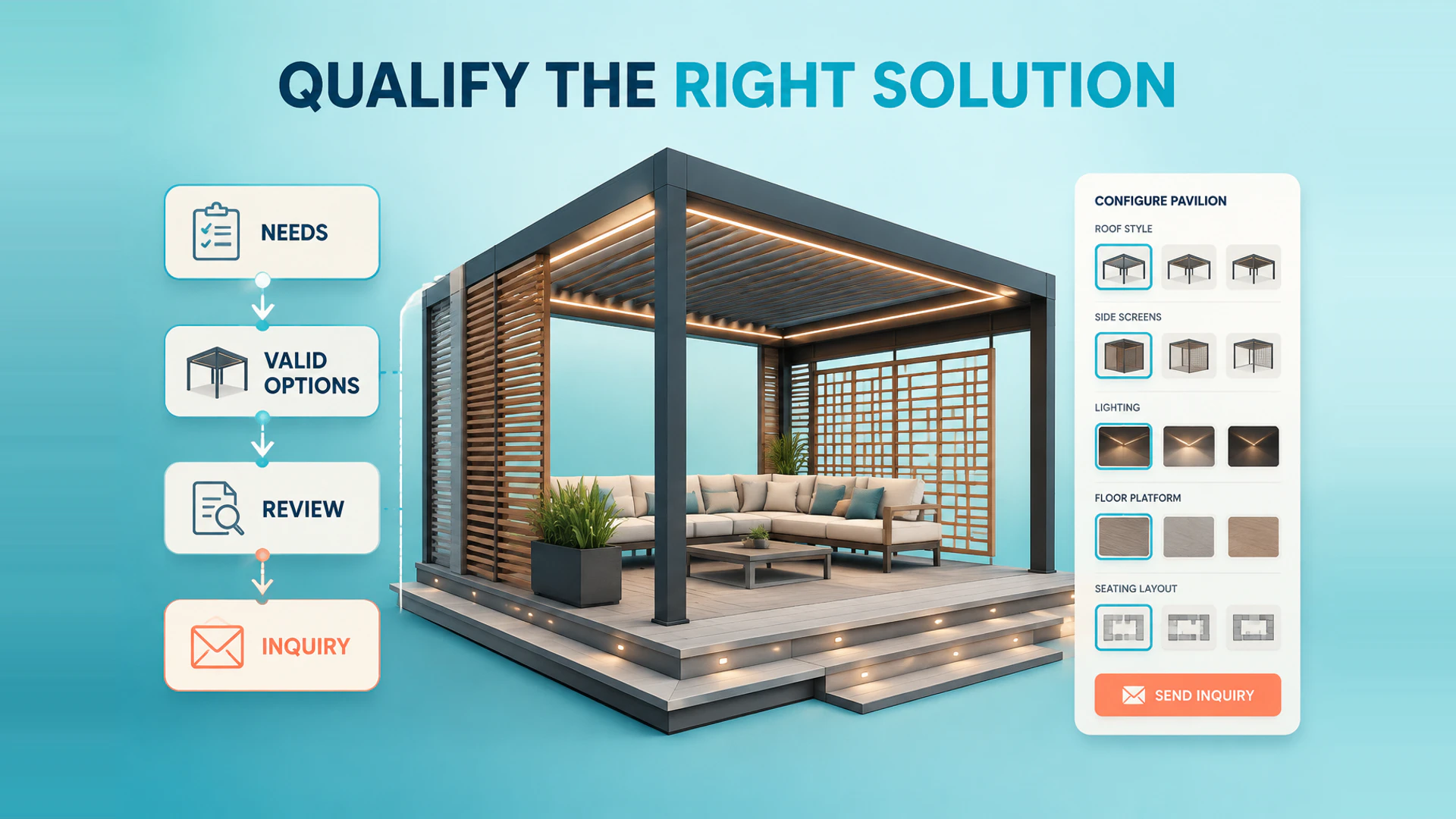
A B2B product configurator does more than display options. Its job is to help a buyer reach a valid, explainable configuration and help the sales team receive enough context to continue the conversation efficiently.
Begin with the qualification path
Complex B2B buyers often start with an application, capacity, installation condition, regulation, or budget rather than a product code. Ask the few questions that narrow the available range before presenting every option. This reduces unnecessary choices and makes the resulting inquiry more useful.
Map each question to a decision or sales stage. An application question may filter product families, a capacity question may remove incompatible modules, and a delivery question may determine whether the result should become an immediate quote or a technical review. Keep the first step short, then reveal more detailed options as the buyer's needs become clearer.
Use rules to protect the sales promise
Dependencies, exclusions, mandatory components, and engineering limits should guide the configuration. A user should see why an option is unavailable and what a valid alternative is. The aim is not to replace technical review; it is to prevent clearly incompatible requests and prepare a stronger first brief.
Show a decision-ready result
The final view should summarize selected modules, key specifications, quantities, assumptions, price status, and the next action. For high-complexity products, use an indicative price or quote request rather than a false instant price. Include the configuration ID in every record so sales and customer can discuss the same result.
The summary should also explain what is not included. State assumptions, unresolved technical checks, lead-time conditions, and any information still required from the customer. This protects the sales promise while keeping the first conversation focused on a specific solution rather than a vague request.
Connect the right information to sales
The form or CRM handoff should include the configuration payload alongside company, market, use case, and required timeline. Keep an auditable mapping between option labels and internal codes. This lets sales validate the solution instead of asking the customer to recreate it.
Use a stable configuration ID and preserve the version of the rules used to produce it. If a specification or price changes later, sales should still know what the customer saw when the inquiry was submitted. For larger deals, the record can include a PDF summary, a bill of materials, or a link back to the saved configuration.
Measure lead quality, not only lead volume
Track completed configurations, quote requests, technical-review requests, and the percentage of inquiries containing a valid configuration. Compare these signals with sales acceptance, response time, quote rate, and opportunity creation. A configurator that produces fewer but better-defined inquiries can be more valuable than a form that generates a larger number of incomplete leads.
Avoid forcing every B2B buyer through a full configuration. Some users need a quick product fit assessment first, while others already know the required specification. Offer a clear route for both and use the captured context to guide the sales follow-up.
Define escalation and human review
Some selections need engineering, compliance, or commercial approval. Mark those states clearly instead of treating every valid visual combination as an approved product. The configurator can collect the context, route the request to the right team, and show the buyer what happens next. This keeps the online experience useful without over-automating complex decisions.
Set a service-level target for follow-up and return the configuration reference in the response. The buyer should not need to describe the whole solution again when a salesperson contacts them.
Explore the industrial configurator solution, the B2B configuration flow guide, and the CYCLONE case. To map your qualification flow, request a project review.
Ready to turn these principles into a project plan?
We can review your product structure, option logic, and target market to define a practical delivery scope and launch priority.