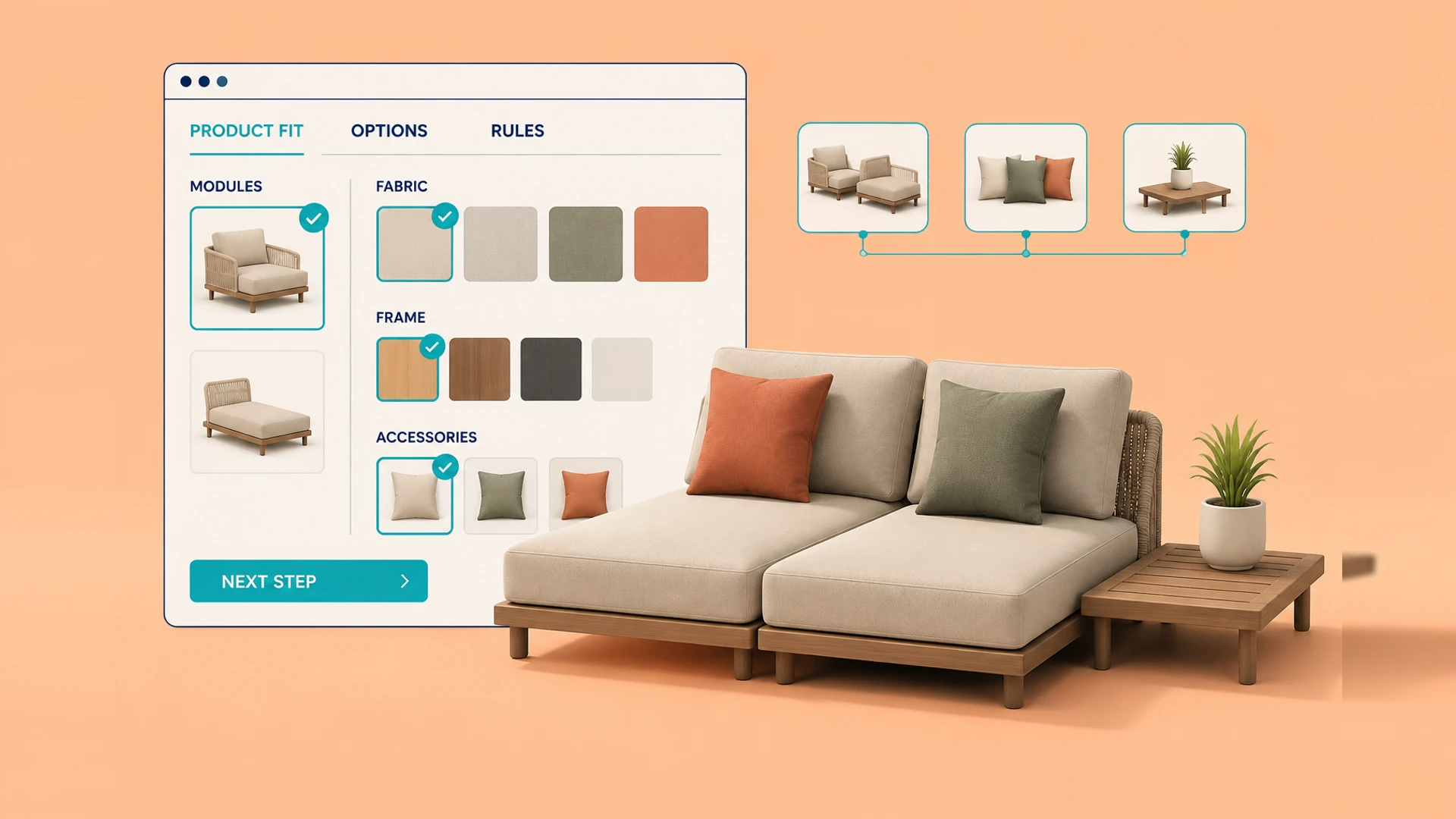
Start with the business problem, not the 3D effect
The strongest configurator projects solve a problem that product photos and specification tables cannot explain. Buyers may need to compare finishes, sizes, parts, modules, or product versions, while sales teams repeatedly explain the same differences.
When a configuration experience helps customers understand tradeoffs, avoid invalid combinations, or submit a more specific inquiry, it has a clear commercial role.
Options have visible differences that buyers need to confirm
Product combinations are difficult to communicate on a standard detail page
Sales, dealers, or support teams repeatedly explain the same choices
A completed configuration should lead to inquiry, quotation, or purchase
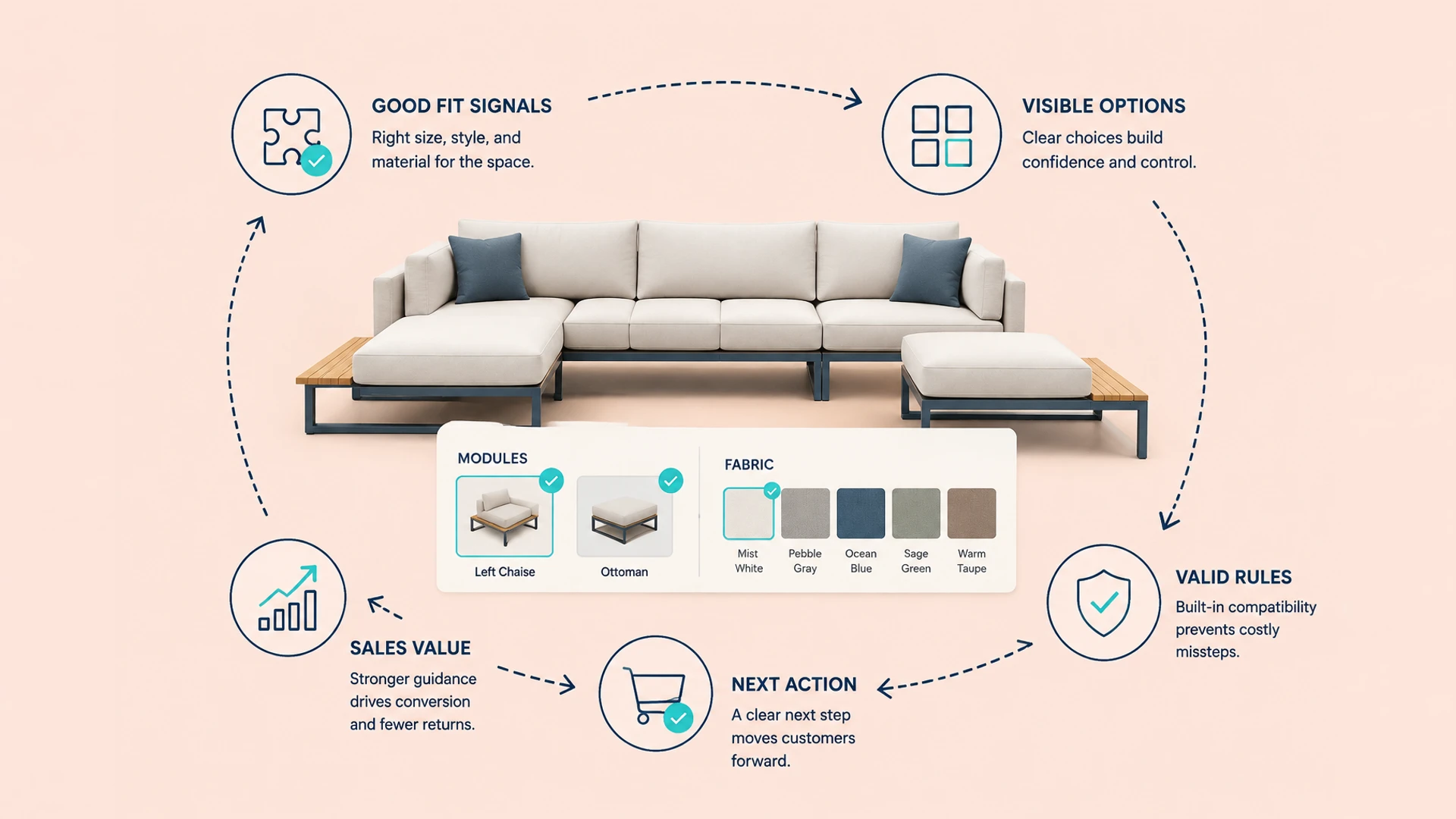
Use three signals for a quick answer
A product does not need a configurator just because it has customization options. A product worth evaluating for a first release usually meets all three conditions: buyers must choose between meaningful alternatives; those choices change the sellable, quotable, or deliverable result; and the business can use the completed configuration to advance a sales process.
| Signal you see | More appropriate next step |
|---|---|
| The product is hard to inspect, but choices do not affect the transaction | Start with a 3D viewer or stronger product presentation |
| Buyers need to compare solutions, but rules or source data are incomplete | Build a proof of concept for one representative product |
| Choices affect appearance, function, price, lead time, or sales discussion | Scope a first 3D configurator release |
When all three signals are present, the value is more than a premium visual effect. The configurator can turn a buyer decision into structured information that sales, quotation, or ordering can use.
Four common product scenarios
Furniture, mobility, industrial equipment, and premium custom goods are frequent configurator categories. Their shared characteristic is that a selection changes appearance, function, price, or delivery conditions.
Furniture: materials, dimensions, and modules need visual comparison
Automotive and mobility: trims, wheels, accessories, and finishes shape preference
Industrial products: specifications and modules have technical dependencies
Premium goods: materials, engraving, graphics, and personalized elements need preview
Score product fit across five dimensions
Use a short workshop to score a representative product line before committing to a full catalog. Give each area 0, 1, or 2 points: 0 means there is no practical need or usable input, 1 means the value or data is partly ready, and 2 means the signal is strong and approved.
| Dimension | What a high score looks like |
|---|---|
| Buyer decision | Customers compare visible or functional choices before they can proceed |
| Commercial impact | The choices affect price, lead time, qualification, or the sellable result |
| Rule clarity | Dependencies and exclusions can be stated and approved |
| Content readiness | Models, materials, names, and option codes can be produced consistently |
| Sales handoff | A completed configuration has a defined owner and next action |
| Score | Recommended action |
|---|---|
| 8 to 10 | Select one product line and proceed with a scoped first configurator release |
| 5 to 7 | Build a proof of concept focused on the weakest rule, content, or handoff input |
| 0 to 4 | Improve product data, sales process, or visual content before asking a configurator to compensate for an unclear offer |
You do not need to begin with every SKU
A first release can focus on a representative product line and validate the most common option paths, inquiry data, and sales handoff. It does not need to model every possibility at once.
Once product structure, asset production, and the business flow work together, adding more SKUs, languages, or commerce features becomes much more predictable.
Prioritize products with high inquiry volume or high explanation cost
Cover the options that meaningfully influence a decision
Keep the data structure expandable for future products and rules
Define the next action after configuration before launch
Ask five questions before starting
Have product, sales, and marketing answer these questions together. The more answers are yes, the more likely a configurator is to create measurable value. If the only goal is to make the product feel more premium, validate the business case first.
- Do buyers regularly compare colors, materials, sizes, modules, or accessories?
- Do choices change appearance, function, price, inventory, or lead time?
- Do sales or dealers repeatedly explain the same option relationships?
- Can the business provide an approved source for product data and rules?
- Is there a clear inquiry, quotation, sharing, or purchase action after configuration?
Define the first-release scope after a strong score
The first release should not demonstrate every capability in the catalog. It should prove that one complete buyer decision can move into a usable business result. Choose a product line with meaningful inquiry volume, relatively clear rules, and a sales team that can continue the conversation.
Select one model or modular product line, not the full catalog
Cover three to five choice groups that change the solution, price, or lead time
Prepare stable labels, codes, rules, and required visual assets for each choice
Define what the buyer receives and what sales receives after completion
Measure inquiry completeness, fewer invalid selections, or quote preparation time in the first release
Once the scope is clear, use the pre-launch preparation checklist to organize the inputs and the 3D product configurator delivery framework to plan rules, assets, integration, and acceptance.
Make sure the product data is viable, not only detailed
Long catalogs do not automatically create a good configuration experience. The key inputs are stable option names and codes, an agreed hierarchy, and a way to state what each option changes. A first release can use a controlled product subset, but it should not rely on unapproved spreadsheet values or rules that only one person understands.
Before modeling every visual variant, confirm which choices must be shown in 3D, which can be summarized in text, and which are sales-only conditions. This keeps the asset scope aligned with the buyer decision and avoids producing 3D content that does not affect a valid result.
When not to build immediately
If the product has almost no options, changes are handled entirely through manual consultation, or the business has not agreed on product data and pricing ownership, a configurator can become an expensive presentation layer. Start with a viewer, a product selection guide, or a proof of concept for one representative product.
The right first release should validate one outcome, such as fewer repetitive questions, more complete inquiries, or less time spent preparing a sales quote.
Ready to turn these principles into a project plan?
We can review your product structure, option logic, and target market to define a practical delivery scope and launch priority.